Parsha 📜 Week 17 (2026) Yitro: A Second Look at Sinai

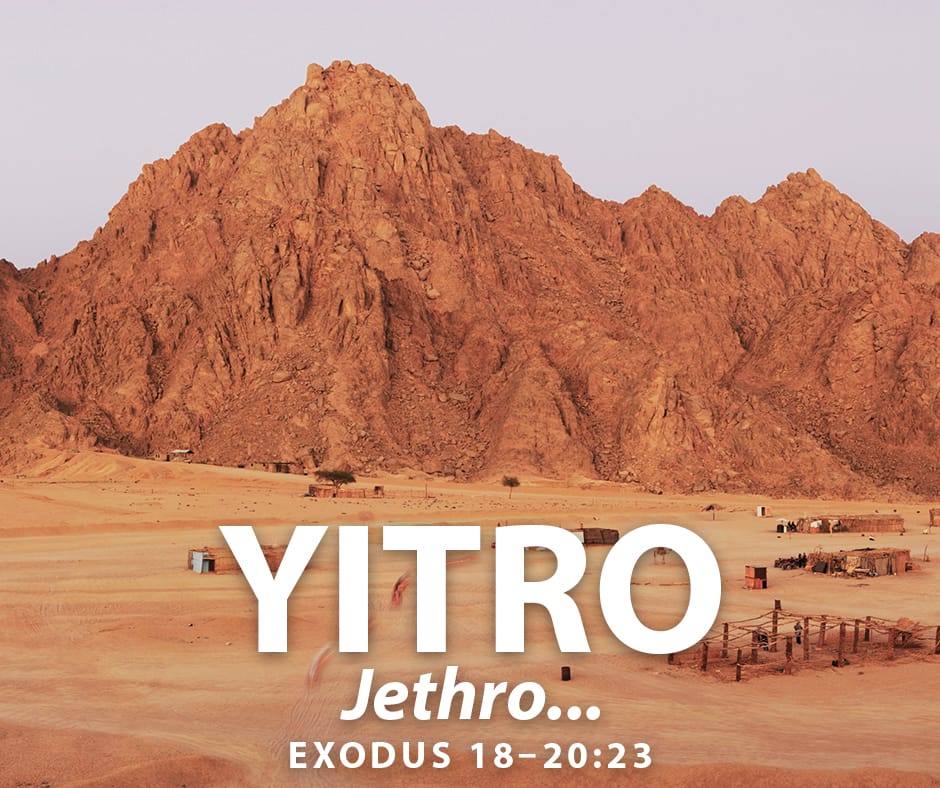
This week’s Parsha is a big one... lots of chapters, lots to sit with.
Before I share any new notes from this year’s read-through, here are all the passages I’m working through for Parsha Week 17 (Yitro / Jethro). Feel free to click any reference to open the text and read along.
| Section | Reading(s) |
|---|---|
| Torah Portion | Yitro / Jethro — Exodus 18:1–20:26 |
| Prophets (Haftarah) | Isaiah 6:1–7; 9:2–7 |
| New Testament (Brit Hadasha) | Matthew 5:1–48; 15:1–11; 19:16–30 Acts 6:1–7 Romans 2:10–29; 7:1–15; 13:8–10 Ephesians 6:1–3 1 Timothy 3:1–14 2 Timothy 2:2 Titus 1:5–9 Hebrews 8:10; 12:18–29 James 2:8–13 1 Peter 2:9–10 1 John 2–5 Revelation 12:10–17 |
The first thing that stood out to me this week is that news of Israel’s deliverance reached Jethro. Before Sinai 🏔️, before commandments 📜, before all the detail of covenant life 🤝, the story starts with a witness on the outside hearing what God did. That detail matters to me — it’s a reminder that the Exodus wasn’t just for Israel’s encouragement, it was also a declaration 📣. God’s power wasn’t hidden, it didn’t happen in a corner — it was an act of God that became known beyond Israel, the whole world 🌍 was paying attention to 👀🔥
The next thing that caught my attention was the order of what happens next. Exodus doesn’t always read like a strict, step-by-step timeline, and Parsha Week 17 felt like one of those moments where the flow is doing something intentional. Right after Israel arrives at Sinai (and before the commandments 📜 unfold in full), we get this whole scene with Jethro, Moses, and the appointment of judges. It reads almost like a pause in the “Sinai moment” to highlight something practical: God isn’t only rescuing a people — He’s shaping His people. A nation needs structure 🏛️, wisdom 🧠, and shared leadership 🤝, not just miracles ✨. Deliverance is real, but so is order!
And then there’s the part with Jethro’s sacrifice 🔥🐑, which honestly felt beautiful to me 🥹. Jethro isn’t even part of the nation of Israel — he’s the priest of Midian — and yet he comes in and offers a burnt offering and sacrifices, and it’s received. Then Aaron and the elders of Israel sit down to eat a covenant-style meal 🍞🍖 in God’s presence. That moment makes me pause, because the text doesn’t show Jethro standing at Sinai hearing commandments — and still, he seems to know how to approach God with reverence.
It’s one of those passages that makes me wonder if God’s ways have always been “in the air” more than we realize ...that His standards of clean/unclean, worship, and sacrifice didn’t just suddenly appear at Sinai, but had been known and passed down in some form long before Israel became a nation. In other words, Sinai isn’t God inventing holiness… it’s God formalizing it for a people He’s calling close.
That contrast hit me even more when I thought about Nadab and Abihu — Aaron’s sons — who later offer “strange” fire 🔥⚠️ before the LORD and are struck down immediately ⚡☠️😳. So Jethro’s moment doesn’t feel casual at all. It feels reverent 🙇, ordered 🧭, and welcomed 😍 I love what that communicates: the God who delivered Israel is also the God who draws near and He teaches His people what it means to worship Him rightly ⚖️.
When I got to Exodus 19, I honestly chuckled a little 😅 — not because it isn’t serious, but because it’s so... human.
The LORD reveals Himself at Sinai in a way that leaves no room for doubt 🚫🤔. The people see the mountain shaking 🌋, hear the voice 🔊, feel the weight of it… and their response is basically: “Okay... please don’t let Him speak again, because if we get any closer, we’re going to die 😨.” It’s like they’re overwhelmed by how holy God is 🔥👑.
And what makes that moment even more striking is what happens later in Exodus: these are the same people who will turn around and make a golden calf.
I get it — Egypt trained them for generations to think in idols and visible gods. But the irony still lands: the people who trembled at the voice of the living God end up bowing to something they can build ⚒️ with their hands 👐.
That contrast hit me personally. It reminds me that there really is a right way and a wrong way to honor God. We don’t get to define worship on our terms, or try to “help” God with something that feels more comfortable or familiar. The call at Sinai isn’t just “believe that God is real.” It’s also: honor Him His way.
The Ten Words — and God’s care for the “outsider”
As we close out this Torah portion and move through the Ten Commandments, I love how the text doesn’t feel like it’s only speaking to the descendants of Abraham, Isaac, and Jacob 👨👦👦 like it’s only for a single bloodline. Even in the commandments themselves, you can hear God’s concern reaching beyond the immediate household 🤍🌍
One detail that stood out to me is how the Sabbath command explicitly includes everyone within Israel’s community life — not just “you,” but your children, servants, and even “the sojourner within your gates.” 💥That matters! 💥 It tells me that God’s vision for holiness and rest isn’t meant for just "the Jews/Jewish". It spills outward 🌊 It makes room for people who are “near” the community, even if they didn’t start there.
And honestly, it makes me appreciate the heart of God even more when I remember Israel came out as a mixed multitude — not a perfectly “pure” group of people. God is building 🏗️ a people 🧑🤝🧑 but He’s also revealing a way of life that is good, ordered, and life-giving. In that sense, I can’t help but believe that when anyone (even an outsider) honors what God lays out here... when they live in alignment with His ways, they’ll experience the fruit of it. God’s ways are not only right… they’re extrremely good! ❤️
Go deeper
A helpful resource I found while studying Parsha Week 17 is a Torah commentary by Ardelle B. from Living Waters Fellowship. If you want to dig deeper, you can read it here:
Haftorah - Isaiah 6:1-7;9:2-7
One of my favorite visuals from this week is in the Haftarah ✨📖 Isaiah is cleansed when the coal 🔥 touches his lips in God’s presence. The BibleProject’s Holiness video 🎥 explains that scene so well and helps not only to connect it to the bigger biblical theme of cleansing 🧼✨ and worship, but also a picture of what Jesus did for us! 💖 If you want to see that theme laid out clearly, watch this before moving on.
Important Questions
1) How does this week’s Torah Portion relate to the Haftarah and Brit Chadasha Portions?
The Big picture: all three readings circle the same core movement: God reveals Himself → people are confronted by holiness → God provides a way to draw near → a community is formed to live His ways.
Sinai + Temple Vision (Holiness & Fear): In Exodus 19–20, Israel trembles at God’s nearness and voice; in Isaiah 6, Isaiah trembles at God’s holiness and is purified so he can stand and serve. Same pattern: holiness exposes, then God makes a way.
Mediator + Access: At Sinai the people want Moses to mediate because God’s presence feels overwhelming. In the Brit Chadasha, Hebrews leans hard into that same theme—approaching God because of the better mediation (and the “Sinai vs. Zion” contrast in Hebrews 12 lines up naturally with Sinai imagery).
Torah “on the heart” & inward obedience: Yitro gives commandments; the Brit Chadasha passages (especially Romans + Hebrews) keep pushing the idea that God’s goal isn’t just external rule-keeping, but heart-level obedience—the kind that produces real holiness and love.
Community order & shared leadership: Exodus 18 is about appointing capable leaders to share the load; Acts 6 mirrors that with the community appointing trusted people so ministry/justice doesn’t break down. Same wisdom: God’s people need structure, not chaos.
“You heard it said… but I say…”: Matthew 5 doesn’t throw Torah away—it presses it deeper, aiming at the heart (anger, lust, truthfulness, love of enemy). It’s Torah with the spotlight turned inward.
2) What is the general theme of this reading and how does it apply to our lives today?
Theme: God reveals His holiness, calls a people into covenant life, and teaches them to worship and live rightly—through reverence, obedience, love, and ordered community.
What that looks like in real life today:
Reverence over casualness: Sinai + Isaiah 6 both remind us God isn’t “safe” in a tame sense... He’s holy. That should shape how we pray, worship, and speak about Him.
Obedience that starts in the heart: The commandments aren’t just “rules to follow,” they’re a life-architecture. And the Brit Chadasha keeps saying the goal is transformation of integrity... doing it even when "nobody’s watching".
Love as the fulfillment, not the shortcut: Love isn’t “ignore the commands,” it’s the true intent of them; honor God, honor people, protect life, protect covenant, protect truth.
Healthy structure & shared responsibility: Jethro’s advice and Acts 6 both say: if you try to carry everything alone, things break. Build systems, delegate, raise leaders, serve wisely.
Room for the outsider: Even in the Torah portion, God’s instructions repeatedly spill beyond just “me and mine.” The community ethic is meant to be a witness—ordered, compassionate, and set apart.